

Forever roses are a human creation. We’ve been blessed with fresh roses in various colors and shapes, but their seasonality made us wonder: could we preserve this beauty for years to come?
Thanks to science, we can. And why create artificial flowers from artificial materials, when we can take a piece of nature, transform it, and keep it in our home?
While we go through each step of giving you the answer to the question: “how are forever roses made”, you’ll see that in the very heart of it lies the “as natural as possible” principle, preserving just the flower as nature created it, plus the longevity we add.

Step-by-Step Process: How Forever Roses Are Made
If the idea behind forever roses is to preserve nature rather than replace it, then the process itself has to follow that same logic.
Nothing rushed, nothing artificial for the sake of convenience. Each step is designed to gently guide a fresh rose from a living state into a preserved one, without losing what made it beautiful in the first place.
Step 1 – Selecting Fresh Roses
It all starts at the exact right moment. Not early, not late, and definitely not “almost ready.”
We harvest roses at peak bloom, when:
- petals have reached full size,
- color is fully developed, and
- the plant’s internal structure is still firm and hydrated.
At this stage, the cell walls are strong and elastic, which is exactly what we need before any preservation begins.
Only high-quality roses are selected. Thick, well-layered petals matter because they hold shape better during the process. You can actually feel the difference. A premium rose has a certain weight and density to it.
Because preservation does not improve a rose; it reveals it, permanently.
Step 2 – Dehydration (Moisture Removal)
Fresh roses are mostly water (about 85%).
Strip that away incorrectly, and you get a brittle, lifeless flower.
Do it right, and you create the perfect foundation for preservation.
We gradually remove moisture in a controlled environment, reducing water content while preserving the cellular structure. The goal is to lower what scientists call “water activity,” which is the key driver behind decay, mold, and enzymatic breakdown.
Too fast, and petals collapse. Too slow, and degradation begins. So this step is all about balance.
Step 3 – Glycerin Preservation Process
This is where the rose stops behaving like a typical flower.
The stem is placed in a plant-based glycerin solution (suitable even for your skin), and through capillary action, the liquid travels upward, replacing residual water and natural sap inside the tissues.
This is the same mechanism a rose uses to drink water in a vase, just with a very different outcome.
Glycerin is hygroscopic, meaning it attracts and retains moisture.
Unlike water, it does not evaporate easily, which is why the petals stay soft and almost velvety instead of drying out.
If you gently press a preserved petal, it gives slightly. That softness is not accidental. It is the direct result of glycerin occupying the microscopic spaces where water once occupied.
This is the step that turns a dried flower into a forever rose.
Step 4 – Color Enhancement (Optional)
Some roses are perfect as they are. Others invite a bit of creative freedom.
Once the structure is stabilized, we can enhance or transform the color using non-toxic dyes that are absorbed directly into the petal tissue.
Because the cells are already filled with the preservation solution, the color distributes evenly, without sitting on the surface.
That is why the finish looks natural, not coated. No flaking, no uneven patches, just a consistent tone throughout the petal.
This is how you get shades like deep black, dusty rose, or true blue forever roses. Colors that nature rarely delivers, but still feel surprisingly authentic as a gift.
Step 5 – Drying and Stabilization
At this point, the rose is preserved, but it still needs to settle into its final state.
We place it in a carefully controlled environment where temperature and humidity are adjusted to stabilize the internal balance between glycerin and plant tissue. This removes any excess surface moisture and ensures the structure holds steady over time.
It is a quiet step, but an essential one. Without proper stabilization, even a well-preserved rose could lose shape or consistency when exposed to normal room conditions.
Final Result
What you are left with is still a real rose, just no longer working against time. It looks fresh, feels soft to the touch, and keeps its form for months or even years without water or sunlight.
The biology that once caused wilting has been replaced with a stable, non-toxic preservation system that holds everything in place.
It’s the same rose you would have picked at its peak, just allowed to stay there.
The Science Behind Forever Roses
What looks like a simple preserved flower is, in reality, a controlled shift in plant chemistry. We are not freezing the rose in time. We are replacing the internal conditions that cause it to age.
How Glycerin Replaces Water
Fresh roses naturally move water through their stems via capillary action. We use that same pathway, just with a different liquid.
The stem is placed in a glycerin-based solution, and over several days, the plant draws it upward. This is not forced or injected. It is the rose doing what it already knows how to do, just with a new substance.
As the solution moves through the vascular system, it replaces the remaining water inside the cells. Glycerin molecules bind within the plant tissue and stay there because they do not evaporate as water does.
The structure remains intact because the cell walls are never collapsed or emptied. They are simply filled with a more stable substance.
Why Roses Stay Soft (Not Dry)
A dried flower loses water and gains nothing in return. That is why it becomes brittle. The cell walls shrink, collapse, and harden.
A preserved rose works differently.
Because glycerin replaces water rather than simply removing it, the internal pressure in cells is partially maintained. Glycerin also attracts small amounts of moisture from the air, which helps keep the petals flexible rather than rigid.
This is why preserved petals feel almost velvety, not papery. You are not touching something dry. You are touching something stabilized at a different equilibrium.
That is the key difference most people feel immediately, even if they cannot explain it. And why we at Ode à la Rose, decided to detail exactly how are forever roses made.
Controlled Environment Factors
None of this works without control. The environment is just as important as the glycerine solution itself.
- Temperature: Typically maintained between 18°C and 22°C. This range prevents rapid evaporation while keeping plant tissue stable during both dehydration and preservation.
- Humidity: Carefully managed around 60–70% during processing. Too low, and petals dry too fast. Too high, and you risk microbial growth (withering and mold) or uneven absorption.
- Timing: This is the variable that cannot be rushed. Dehydration, absorption, and stabilization each take days, sometimes weeks, depending on the rose variety and size.
Precision matters here. Small deviations in any of these factors can change texture, color absorption, or longevity.
Which is why forever roses are not just treated, but calibrated by our trained flower professionals.
How Long Does the Process Take?
It’s not instant, and it’s definitely not one-size-fits-all. In most commercial settings, preserving a rose takes anywhere from 4–5 days to 2–3 weeks, depending on how high-end the result needs to be.
The reason it varies so much comes down to a few very specific, very practical factors.
1. Where the roses come from (and how thick they are): Premium preserved roses are often Ecuadorian, grown at high altitude, which gives them larger heads and thicker petals. They look stunning, but they take longer to preserve because the solution has to travel through more layers. Smaller, thinner roses process faster, but they don’t give that same “full” look.
2. Exactly when they’re cut: Timing is strict. Roses are harvested when they’re about 80–90% open, not fully bloomed. If they’re less bloomed and more closed, they won’t develop properly after preservation. And if they’re fuller, the petals won’t hold their shape. This single decision affects the entire process.
3. How the preservation is actually done: This is where most of the time difference comes from:
- Glycerin + stabilizing solution: takes several days to around 2 weeks. The plant’s natural moisture is slowly replaced, so the petals stay soft, not dry.
- Freeze-drying: can take 2–3 weeks because the rose is frozen, then the moisture is removed under vacuum. This keeps the exact shape but requires more time and equipment.
4. Color infusion (this part is slower than people think): The rich reds, soft pinks, even blues, aren’t just surface dyes. The color is absorbed through the stem and distributed into the petals, which takes time to look even and natural. Rushing this step leads to patchy or artificial-looking results.
5. Drying + stabilization (the “don’t touch it” phase): After everything is done, roses are left to stabilize for a few days. This is where they settle into their final texture. Skip this, and the rose can feel too moist or lose its structure later.
So yes, it takes time, but not for the sake of it.
Are Forever Roses Natural or Artificial?
They are 100% natural flowers. Forever roses are real, fresh roses that have been preserved.
They’re not artificial flowers made from synthetic materials. The petals, shape, and texture all come from the original flower.
What changes is the internal composition. Water and sap are replaced with a plant-based solution, which stops the natural aging process.
So they are not fake. They are real roses, simply preserved to last.
Fresh vs Forever vs Dried Roses: What’s the Difference?
At first glance, they can look similar. But once you smell them, or look at them closely, the differences become obvious. And no, we are not just talking about the difference regarding the maintenance routine.
You’re not choosing between three “types of roses.” You’re choosing between three completely different experiences of the same flower.
Texture
You can spot it with a single glance at the petals.
Fresh roses look full, vivid, and hydrated. Preserved roses hold that same fullness, but with a slightly more settled, composed feel, with fullness and almost the same fresh appearance, but with no smell in the air.
And the dried roses look lighter, thinner, almost weightless, because the moisture inside them has evaporated.
It’s subtle, but once you’ve seen all three side by side, you don’t confuse them again.
Appearance
You’ll notice the difference within days, even if you’re not paying close attention.
- Fresh roses keep changing before your eyes. They open wider, the edges soften, colors deepen, and then slowly dull. By the end, they don’t look anything like the day you got them.
- Forever roses don’t go through that cycle. They’re set at their peak, so what you see on day one is what you’ll keep seeing weeks or months later. No extra blooming, no drooping, and no browning edges creeping in.
- Dried roses already look like they’ve been through that entire process. The colors are softer, more muted, sometimes slightly uneven. The shape is a bit tighter or shrunken, and the whole flower feels more “finished” than fresh.
Lifespan and Durability
Lastly (and this is where things get a bit unfair), not all roses are playing the same game.
A fresh rose is on a countdown from the moment it’s cut. On average, you’re looking at 5 to 7 days, maybe up to 10 if you’re really attentive with water, trimming, flower food, and placement. The reason is simple: it’s still a living structure losing water and breaking down naturally.
A forever rose operates on a completely different system. Because the water inside the plant has been replaced with a stabilizing solution, there’s no dehydration happening in the same way. That’s why it can last 1 to 3 years, sometimes even longer if kept away from direct sunlight and humidity. It’s not “alive,” so it’s not actively decaying either.
Dried roses also last long, often several months to a year, but for a different reason. They’ve already gone through the full drying process, so there’s no more change happening internally. The trade-off is durability. Without moisture or structural support inside, they become fragile, prone to breaking, shedding, or reacting to humidity in the air.
So, in simple terms: fresh roses are short-lived but dynamic, forever roses are long-lasting and stable, and dried roses sit somewhere in between, long-lasting but far more delicate.
Are Forever Roses Made by Hand or Machine?
Both are used, but not in the way most people imagine.
The core preservation process relies on controlled environments and precise conditions. Temperature, humidity, and solution balance are monitored with technical accuracy because even small variations can affect how the rose absorbs glycerin or holds its structure. That part leans on equipment and scientific control.
But the flower itself is handled by people at every critical stage.
- Selection is done by eye and touch.
- Positioning the stems for absorption,
- monitoring their progress,
- adjusting timing,
- inspecting the final result.
All of that requires human judgment.
There is no calibrated machine that can “decide” if a rose has the right density, the right symmetry, or the right moment of bloom.
So while the process is supported by technology, the outcome is still shaped by human hands.
Not mass production. More like assisted craftsmanship.
Can You Make Forever Roses at Home?
Technically, you can try. Realistically, you will not get the same result.
At home, most people experiment with air drying, silica gel, or basic glycerin solutions.
These methods can preserve the shape of a flower, but they do not fully replicate the internal replacement of water with a stable preserving agent under controlled conditions (the technical and machine stuff we discussed previously).
You might end up with something decorative, but not something that feels like a fresh rose months later.
So yes, it is possible to preserve a flower at home. But creating a true forever rose is a different level entirely.
When Are Forever Roses Used?
Whenever the connection feels special. For the big life moments, when you want flowers without the usual trade-off.
With a preserved rose gift, there’s no countdown, no maintenance, and no quiet decline in the background.
Just the moment, held in place.
1. Gifts
Some gifts are meant to be enjoyed. Others are meant to stay.
A preserved rose gift falls into the second category.
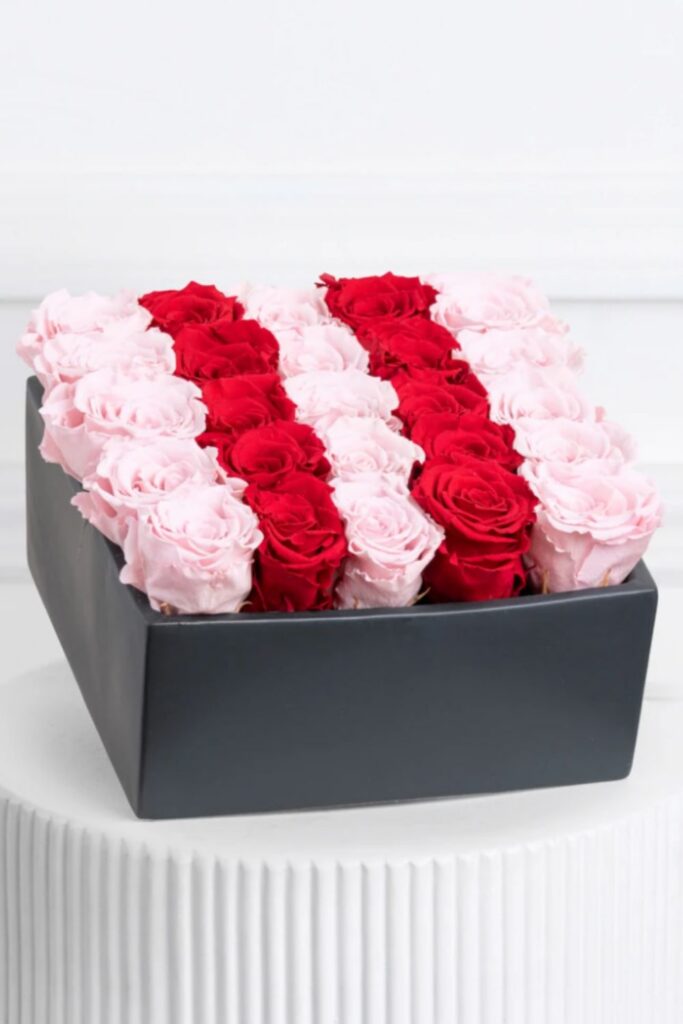
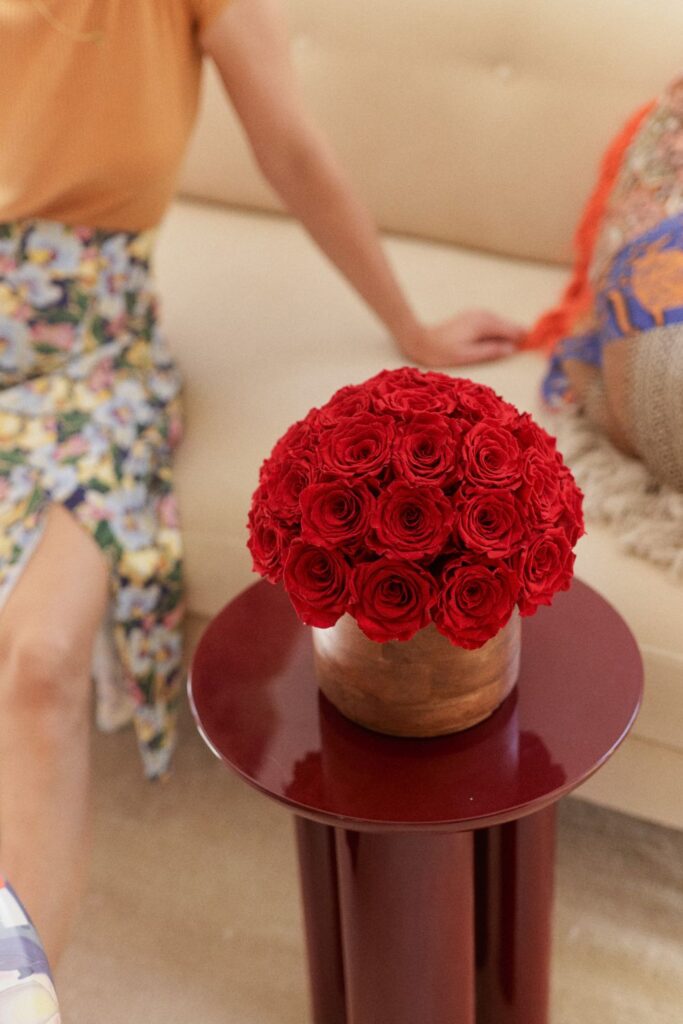
Anniversaries are the occasion when forever roses make the most sense. A red preserved rose does what a fresh one does symbolically, just without fading three days later. And it lives the same emotional hype as a 100-rose bouquet. Except it won’t get thrown in the bin eventually.
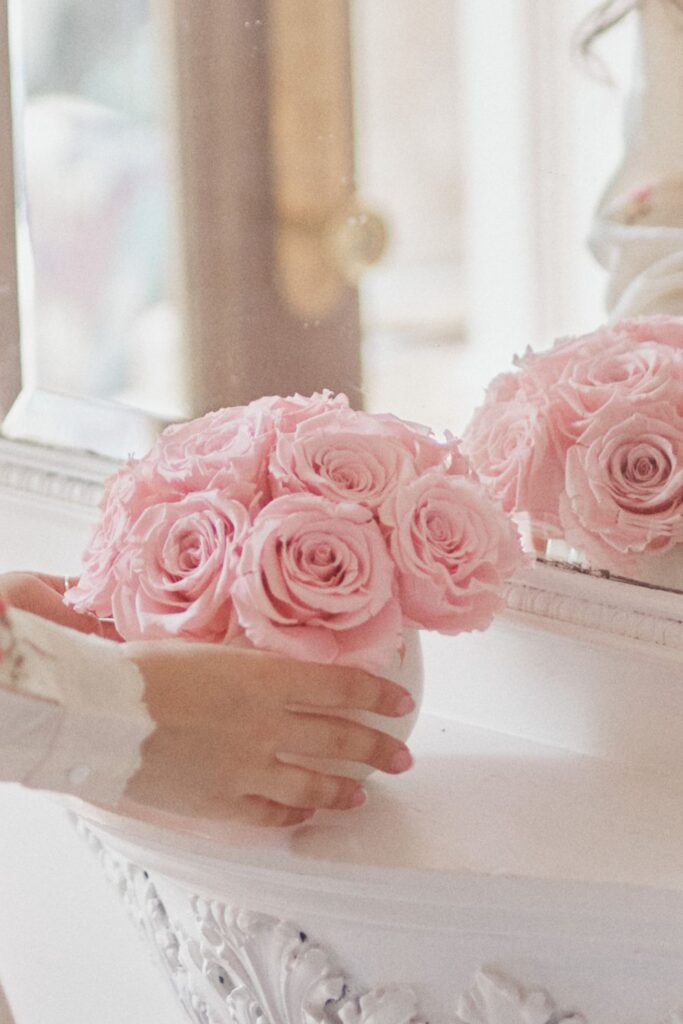
Birthdays and Mother’s Day lean softer. Pink preserved roses feel personal without trying too hard. Plus, they’re the “official” Mother’s Day flower choice.
And what better gift to celebrate a new baby? It is one of the most important moments for a woman and a family. And a preserved rose arrangement would last much longer (depending on care, it might even wait to meet the baby fully grown up), making for a historical gift.
The pattern is easy to spot. If the moment matters, people tend to choose something that lasts longer than the moment itself. That’s the moment you realize the occasion is just perfect to gift preserved roses.
2. Home Decor
Fresh flowers look great. For a few days. Then they start asking for attention.
Forever roses skip that entire phase. You place them once, and they stay exactly as you left them. No water, no repositioning, no slow decline you try to ignore (except the occasional dusting-off).
They also behave differently in a space. A preserved rose does not “age” visually, so it becomes part of the interior, not something temporarily sitting on top of it.
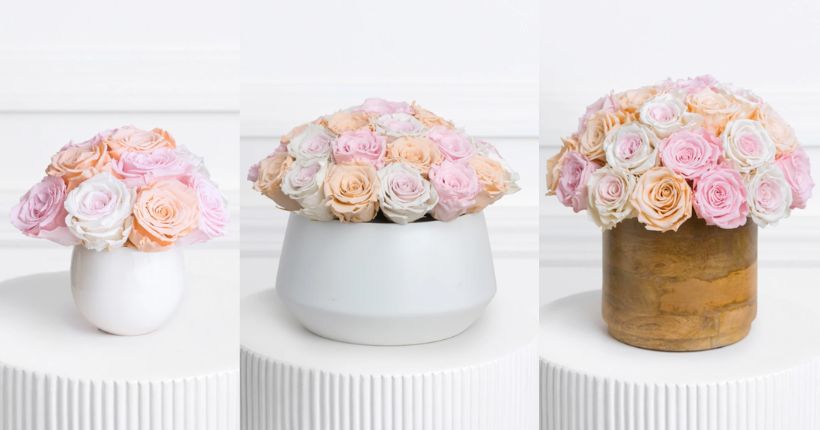
Go neutral and pastel-colored if you want it to blend in. Go red if you want it noticed. Either way, it stays consistent, which is the whole point.
3. Events and Displays
Events are where fresh flowers quietly struggle. Timing, temperature, transport… Too many variables.
Forever roses remove all of that. What you set up is what people see, hours or even days later. No surprises.
That is why they work so well for weddings, especially with white preserved roses, where visual consistency matters. The same applies to displays, retail setups, or anything that needs to look polished from start to finish, from grand openings to big graduation ceremonies.
They are not just decorative here. They are reliable.
Conclusion
So, after diving deep into the science, the straightforward answer to “how are forever roses made” is this: We take a real, perfect rose and gently replace its water with a plant-based glycerin solution.
This five-step process is less about ‘making’ a new product and more about preserving a perfectly natural creation.
In the end, forever roses are a beautiful, lasting compromise: nature’s best, preserved by human care.